
A garden pond planted with species native to Polish waterways has a structural advantage over one planted with ornamental hybrids or exotic species. Native plants are already adapted to local temperature swings, day-length cycles, and the mineral composition of Polish surface water. They attract the insect and amphibian species that complete the ecological web of the pond, and most are reliably winter-hardy down to the temperatures found in the coldest regions of the country (USDA zones 5–6).
This article organises the most practical native and naturalised pond plants by their position in the water column: emergent (rooted in shallow water with stems and leaves above the surface), floating-leaved (rooted, with leaves resting on the surface), and submerged (fully underwater).
Emergent Plants
Emergent plants occupy the shallow margins of the pond, typically in 5–30 cm of water over their crowns. They provide structure for dragonfly larvae and frogs to exit the water, create shaded refuges in the margins, and absorb nutrients directly from the sediment and water column.
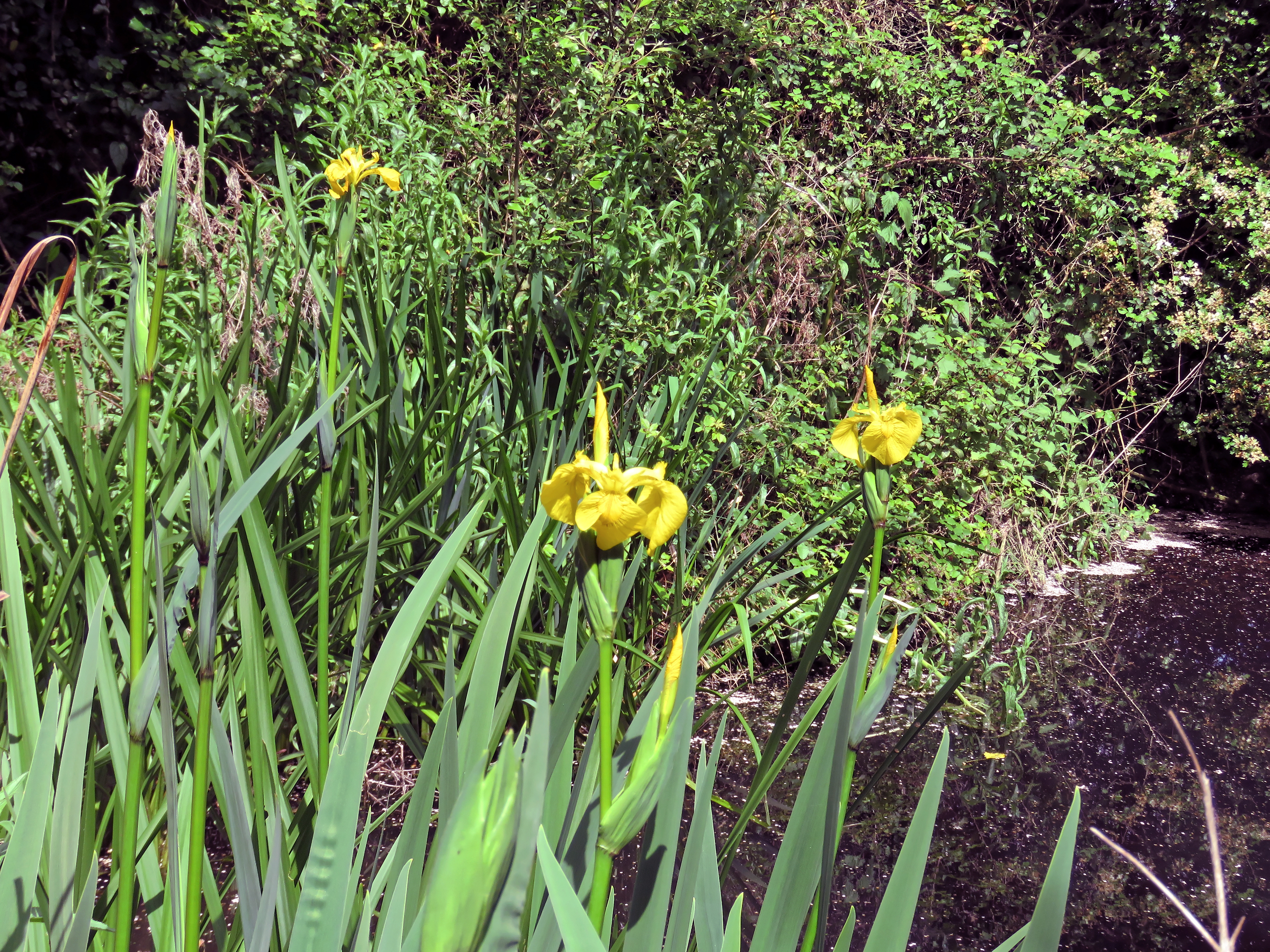
Iris pseudacorus — Yellow Flag Iris
One of the most recognisable native wetland plants in Poland, Iris pseudacorus grows in the margins of rivers, ditches, and lakes throughout the country. In a garden pond it tolerates water over its crown to about 20 cm and grows in standard garden soil with no special treatment. It flowers in May and June with bright yellow flowers, providing an early visual element when water lilies are not yet in leaf. It spreads vigorously by rhizome and should be divided every two to three years to prevent it from taking over shallower zones. USDA zone 4.
Caltha palustris — Marsh Marigold
Caltha palustris is a low-growing emergent that flowers very early — sometimes before ice has fully cleared in March — with bright yellow flowers above kidney-shaped leaves. It prefers the shallowest margins, growing in wet soil or up to 5 cm of water. It dies back partially in high summer and regrows in autumn. Useful for providing early-season visual interest and as a food source for early-flying insects. USDA zone 3.
Typha latifolia — Common Bulrush
The iconic bulrush is native to Poland but should be considered with care in small ponds. Its rhizomes spread aggressively, can penetrate butyl rubber liners, and will quickly dominate a pond under 6 m². Where space allows, the narrower Typha minima (dwarf bulrush) is a more manageable alternative, growing to 75 cm and contained more easily in a submerged container. Common bulrush is better suited to naturalistic ponds with earth margins and at least 8–10 m² of water surface. USDA zone 3.
Alisma plantago-aquatica — Common Water Plantain
Alisma plantago-aquatica is a mid-height emergent with broad oval leaves and branching stems of small pale pink flowers in July and August. It grows in water up to 30 cm deep, self-seeds freely, and provides structural diversity alongside iris and bulrush. The seed heads are also used by seed-eating birds in autumn and winter. USDA zone 5.
Floating-Leaved Plants
Floating-leaved plants root in the deeper zones of the pond (20–80 cm depth) and produce leaves that rest on the surface. Their primary ecological function is shading — reducing light penetration to suppress algae — while their leaf surfaces are used by dragonfly larvae for emergence and by frogs for basking.
Nymphaea alba — White Water Lily
The native white water lily is the most effective surface-shading plant for Polish garden ponds. It grows in 30–80 cm of water over the crown and spreads to cover several square metres once established. Flowers appear from June to August. It is reliably hardy throughout Poland (USDA zone 4) without any winter protection. The rhizomes should be planted horizontally in a wide, shallow container filled with aquatic compost or heavy garden soil without added fertiliser.
For smaller ponds (under 4 m²), Nymphaea alba grows more vigorously than most ornamental hybrid lilies and may require division every three to four years. A single plant can cover 2–4 m² of surface in its third year.

Nuphar lutea — Yellow Pond Lily
Nuphar lutea is native to rivers, lakes, and slow-moving waterways across Poland and is more tolerant of shade and depth than Nymphaea alba. It grows in 30–150 cm of water and will establish in conditions where the white water lily would struggle — a partially shaded pond or one with high water flow. Its small, globe-shaped yellow flowers appear in June and July. The rhizomes are very vigorous; in small ponds, containment in a basket is essential. USDA zone 4.
Submerged Plants
Submerged oxygenating plants are the main biological filter in a plant-based pond management system. They absorb dissolved nutrients (nitrate, phosphate) and produce oxygen during daylight hours. They also provide habitat and spawning substrate for fish and amphibians.
Myriophyllum spicatum — Eurasian Watermilfoil
Myriophyllum spicatum is native to Poland and common in nutrient-rich standing and slow-moving water. In a garden pond it produces dense, feathery underwater growth that absorbs nutrients efficiently. It is fast-growing in warm conditions but dies back in winter and regrows from rootstock. It provides important spawning habitat for fish. USDA zone 4.
Note: Myriophyllum aquaticum (parrot feather) is a popular but non-native alternative from South America that is invasive in some European habitats. The native M. spicatum or M. verticillatum are the appropriate choices for Polish garden ponds.
Ceratophyllum demersum — Rigid Hornwort
Hornwort is rootless, floating freely in the water column, and one of the most effective oxygenators and nutrient absorbers available. It does not need to be planted, simply dropped in at a density of one bunch per 0.2 m². It tolerates a wide range of light and temperature conditions and overwinters as resting buds that sink to the bottom and regrow in spring. USDA zone 5.
Planting Zones and Depths Summary
| Plant | Zone | Water depth over crown | USDA hardiness |
|---|---|---|---|
| Iris pseudacorus | Emergent (margin) | 0–20 cm | Zone 4 |
| Caltha palustris | Emergent (very shallow) | 0–5 cm / wet soil | Zone 3 |
| Alisma plantago-aquatica | Emergent | 5–30 cm | Zone 5 |
| Typha minima | Emergent | 0–15 cm | Zone 5 |
| Nymphaea alba | Floating-leaved | 30–80 cm | Zone 4 |
| Nuphar lutea | Floating-leaved | 30–150 cm | Zone 4 |
| Myriophyllum spicatum | Submerged | 20–100 cm | Zone 4 |
| Ceratophyllum demersum | Submerged (free-floating) | Floats freely | Zone 5 |
Sourcing Native Plants in Poland
Native aquatic species are available from specialist nurseries and, increasingly, from general garden centres that stock clearly labelled native plants. When purchasing, confirm the species name in Latin — common names vary by region and can refer to multiple species. Several organisations in Poland, including local branches of Polskie Towarzystwo Botaniczne (Polish Botanical Society), organise plant swaps and provide guidance on sourcing locally propagated native material.
Collecting plants from natural waterways is subject to Polish environmental protection law. Many species are protected under the Act on the Protection of Nature (Ustawa o ochronie przyrody), and removal from natural habitats without a permit is not permitted. Purchasing nursery-propagated stock avoids this issue entirely.
Reference: USDA hardiness zones referenced above correspond to the standard international scale. Most of Poland falls in zones 5–7 depending on region; the coldest areas (northeastern Poland near Suwałki) approach zone 4 in severe winters. Plant hardiness data from the Royal Horticultural Society and Polish Botanical Garden databases was used for the table above.
Image credits: Wikimedia Commons. Nymphaea alba — CC BY-SA 3.0. Nuphar lutea — CC BY-SA 3.0. Iris pseudacorus — CC BY-SA 2.0.